

h
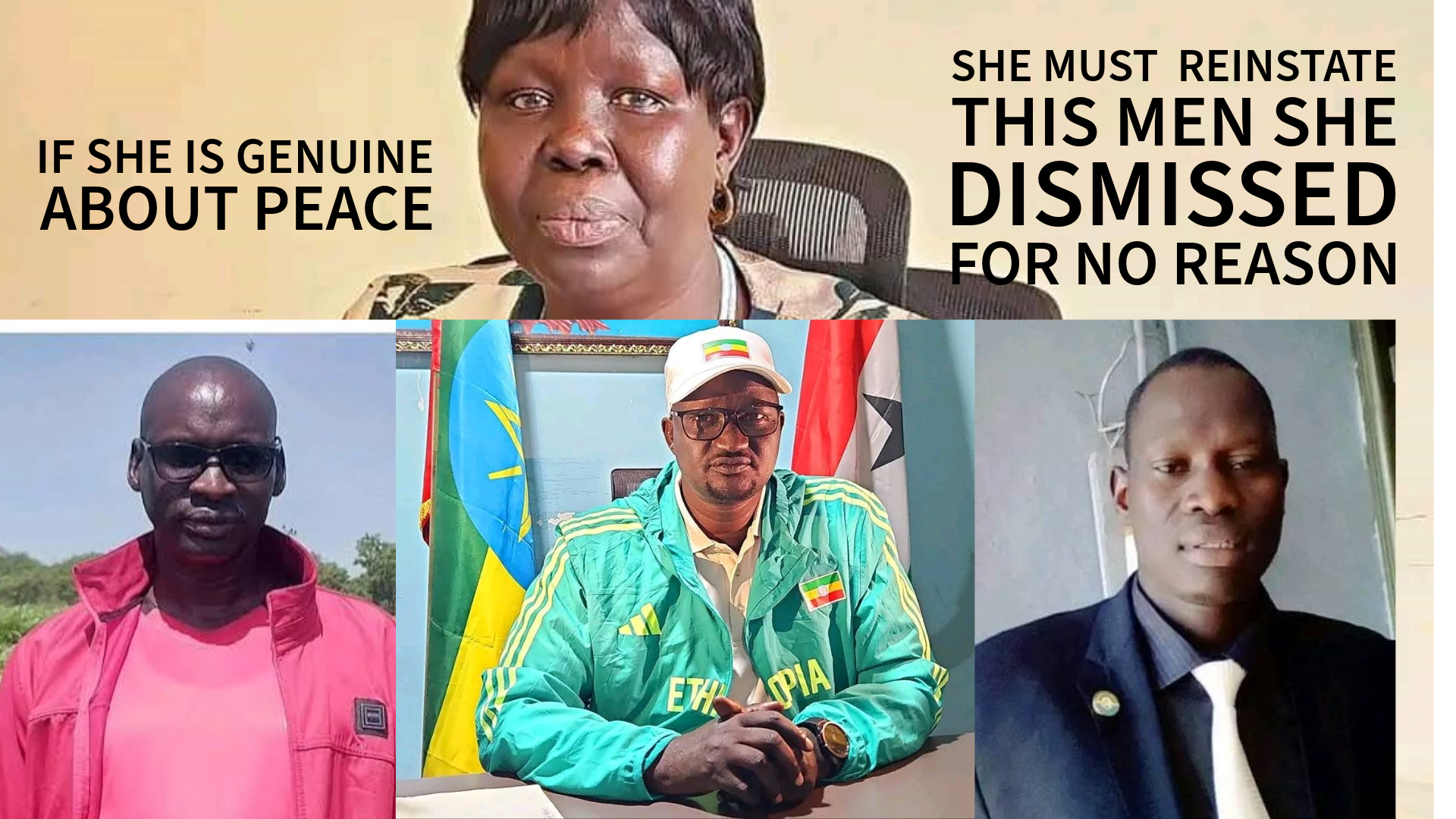
President Alemitu, Honourable Pal, Dr Mun and Nhial Yat
Honourable Pal Tut, Dr Mun Wal, Honourable Nhial Yat and several other Nuer representatives who were dismissed, imprisoned or politically sidelined under Alemitu Omot met their fate not because they had been proven guilty of crimes, but because they refused to follow a political course they believed would put their people at risk. They stood against what they perceived as a campaign of intimidation, displacement and violence targeting the Nuer population.
Dr Mun Wal was reportedly the first major casualty of Alemitu’s dismissal spree. His refusal to cooperate with efforts to remove his people from Makhot Kebele allegedly placed him on a collision course with the president. At the time, concerns were also being raised about pressure on public employees over their job security, while armed groups allegedly linked to the local leadership were repeatedly attacking Tharphaam and Pulkota.
Gambella’s carnage cannot be explained solely by pointing fingers at terrorists carrying weapons. Political leadership must also be held accountable for the environment in which violence is allowed to develop. Whether under President Omot or Alemitu herself, the Anyuak political leadership must answer serious questions about its role in the escalating insecurity and the allegations that political structures and resources were used to facilitate attacks against Nuer communities.
For too long, communities across Gambella have lived under a climate of intimidation and insecurity. Allegations that armed groups have been financed through revenues associated with gold mining deserve independent investigation. If public resources or mining revenues have been used to support armed groups responsible for attacks against Nuer civilians in Gambella town and Itang, those responsible must face the full force of the law.
People such as Honourable Pal Tut, Jacob Nhial, Dr Mun Wal and Honourable Nhial Yat were either imprisoned, dismissed or politically marginalised. Their treatment raises serious questions about whether those who advocated peaceful coexistence were deliberately pushed aside because they stood in the way of a political agenda that threatened the place of the Nuer in Gambella.
The situation changed dramatically when killings extended to the Habesha community. Violence that had affected Nuer communities for years could no longer be treated as an internal Gambella issue. When reports of attacks against Habesha civilians escalated, with claims of approximately seven people being killed per week, the Ethiopian National Defence Force (ENDF) finally became involved in pursuing armed groups accused of terrorism.
Whether the military intervention received Alemitu’s approval or not, its involvement exposed a reality that had long been denied or downplayed. Gambella was not as peaceful as the regional leadership had repeatedly portrayed it.
For years, Alemitu and other regional officials had spoken about development, trade and tourism not mentioning anything about the need for peace.
Yet, from the perspective of communities experiencing violence, those promises often appeared disconnected from the reality on the ground. Development cannot be built on intimidation, selective justice and the exclusion of political representatives who challenge the government.
Now that Alemitu has begun speaking more openly about peace and appeared to be taking action against armed groups, the public has every reason to demand evidence of genuine commitment rather than empty words and to accept another round of political rhetoric.
If the President genuinely wants Gambella to believe that she is serious about peace, she must begin by reinstating the Nuer MPs she dismissed for standing up for peaceful coexistence. Some of these MPs include Dr Mun Wa, Honourable Nhial and Honourable Pal .
Reinstating these representatives would be an important demonstration that political disagreement is not a crime and that representatives who defend their communities should not lose their positions simply because they refuse to endorse the government’s approach.
But reinstatement alone is not enough. With a parliament that genuinely represents the interests of all communities and supports peaceful coexistence, Alemitu should champion legislation that establishes tougher penalties for anyone who murders, injures or participates in organised violence against another person on the basis of ethnicity.
Such legislation should provide for life imprisonment for the most serious offences, including ethnically motivated murder, subject to due process and the protections of the law. It should apply equally across Ethiopia’s ethnic groups residing in Gambella whether, Sidama, Amhara, Tigre. Kambatta or anyone from any other region who live in Gambella .
There must never be one standard of justice for the Nuer and another for the Habesha, Anyuak or any other Ethiopian community.
Gambella does not need selective peace, selective justice or political leaders who condemn violence only when it reaches their own communities. It needs equal protection, accountability and a political leadership committed to protecting every civilian, regardless of ethnicity. Until that happens, Alemitu’s declarations of peace will continue to face legitimate questions about their sincerity.
This article ws written by Pam Chuol Joack, a Gambella Vision Contributor and an Analyst in Gambella Affair