


The peaceful demonstration underway across Anywaa Zone, calling for peace, national unity and an end to conflict in Gambella Peace
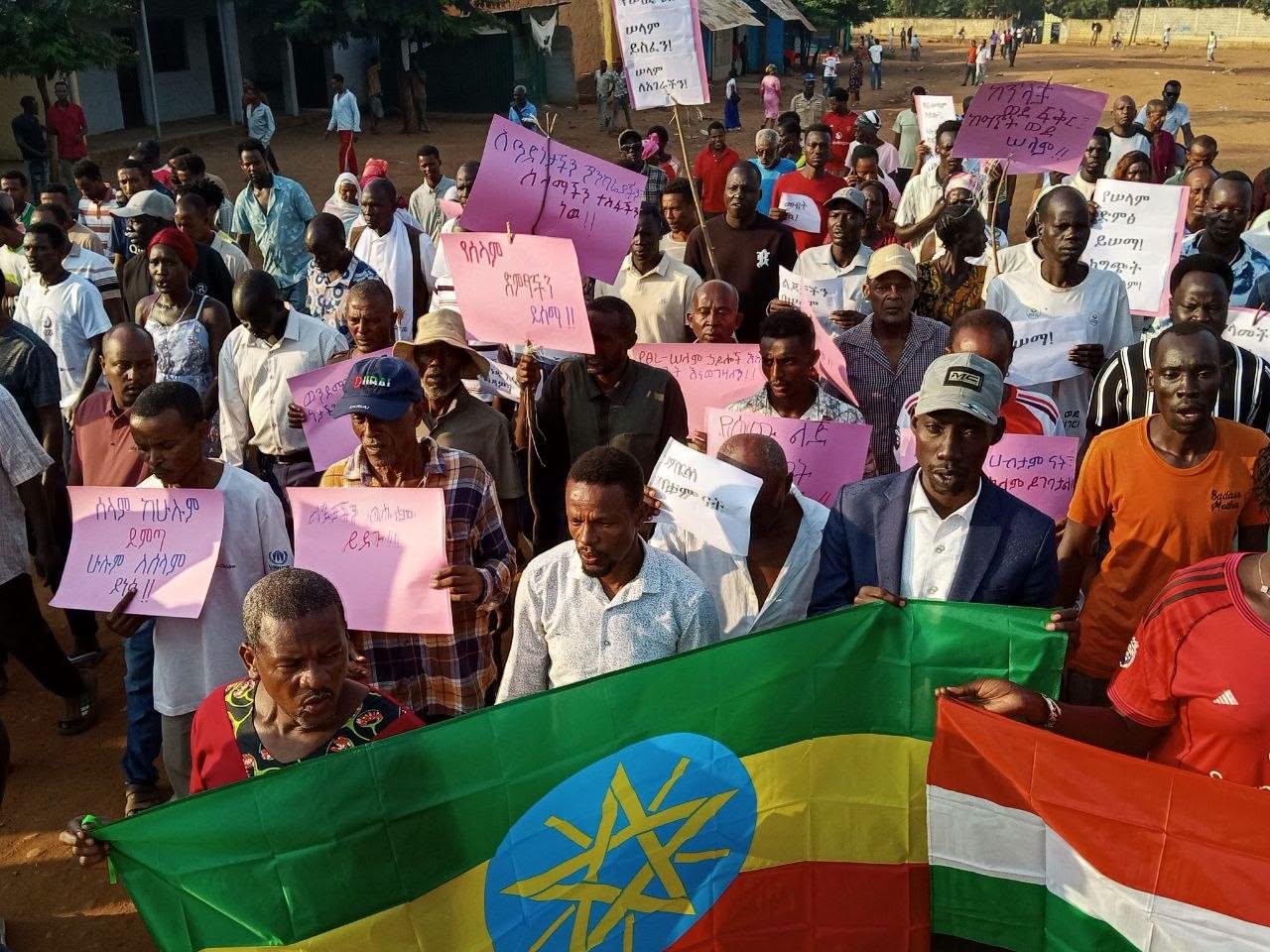
Peace Protestors in Gog Woreda
Region, presents an important opportunity to examine the growing gap between public messages of peace and the security concerns facing communities on the ground.
While peaceful demonstrations and appeals for unity are legitimate expressions of public concern, they cannot, by themselves, demonstrate that peace has been restored or that civilians are adequately protected.
At a time when Gambella continues to face reports of deadly attacks, gunfire, displacement and disruption to civilian movement, the central issue is not simply whether residents are gathering to demand peace, but whether the authorities responsible for protecting them are delivering tangible results.
Under the leadership of Regional President, Alemitu Omod, Gambella’s security situation deserves much closer public scrutiny. When Alemitu assumed office on August 12, 2024, expectations for improved peace and stability were high, particularly following a difficult period of political and security challenges.
Her commitment to ending bloodshed created an expectation that the regional administration would take effective measures to protect civilians and address the insecurity affecting communities.
Yet the incidents reported in September and October 2026 have renewed serious concerns about civilian safety and the effectiveness of the government’s response. The reported September 18 attack on passenger vehicles along the route connecting Gambella City with Abol, Itang Special Woreda, Kule refugee camps and areas of the Nuer Zone, alongside subsequent reports of violence in Itang and Gambella City, underscores the need for a transparent assessment of what the administration has achieved and what remains unresolved.
These incidents have different reported circumstances, and their connections must not be assumed without evidence. Nevertheless, their cumulative impact demands more than another general appeal for peace.
The demonstration’s message of unity may be meaningful, but the public must not confuse a peaceful gathering with a peaceful security environment. Residents cannot measure peace solely through slogans, speeches, public appearances or demonstrations attended by religious leaders and prominent community figures.
They experience peace through their ability to travel without fear, access healthcare, send their children to school, attend university, operate businesses and return home safely. When insecurity disrupts these ordinary activities, the presence of people publicly calling for unity does not erase their difficulties.
If the affected road remains closed, if communities continue to experience insecurity, or if residents are unable to move freely because of credible threats, those realities must receive the same attention as the demonstration itself.
The current status of the road and other reported security conditions must be independently verified rather than assumed, but they cannot simply be pushed aside in favour of a more reassuring public narrative.
This is where Alemitu Omod’s administration must be held accountable. The regional government cannot rely on appeals for national unity while leaving legitimate questions about civilian protection, investigations and security measures unanswered.
The public deserves a clear account of the actions taken following the reported attacks, the progress of investigations, the measures implemented to protect vulnerable communities and the steps being taken to restore safe movement.
It is also necessary to establish what the authorities know about the armed actors involved in reported incidents, what evidence has been gathered and whether those responsible are being pursued through lawful processes.
If the administration has made meaningful progress, it should present verifiable evidence. If serious gaps remain, the public deserves an honest explanation. General statements about peace cannot substitute for a credible account of government performance.
There is also a fundamental difference between promoting peace and demonstrating that the conditions necessary for peace actually exist. Peace initiatives can contribute to reconciliation, and community leaders have an important role in discouraging violence.
However, these efforts must complement effective security measures rather than distract attention from their absence or inadequacy. A government may welcome demonstrations calling for peace, but it must also confront the circumstances that make such demonstrations necessary.
The regional administration should not be judged by the number of public events promoting unity, but by whether its policies and actions are improving civilian safety, strengthening accountability and restoring public confidence in the institutions responsible for security.
The political significance of this demonstration therefore extends beyond its slogans. If the gathering is being presented by political actors as evidence that Gambella is peaceful, that interpretation must be tested against independently verified conditions across the region. A public demonstration cannot establish that the security crisis has ended, just as reports of violence alone cannot establish that every part of the region is experiencing the same conditions.
Responsible reporting must examine both the public message and the lived experiences of affected communities. It must also investigate who organized the demonstration, what its participants are demanding beyond general calls for unity, and whether their concerns have been acknowledged by the authorities.
Without that scrutiny, coverage risks amplifying a reassuring political message without adequately establishing whether it reflects the realities experienced by residents.
Questions have also been raised about whether the regional administration understands the identities and motivations of armed actors responsible for insecurity and whether political or ethnic considerations influence its response.
Such concerns warrant serious investigation if credible evidence supports them. However, the identities of the perpetrators, the administration’s knowledge and any alleged protection of particular actors must be established through reliable evidence rather than assumption.
No individual or administration should be declared responsible for specific attacks without substantiation. Equally, no authority should be shielded from legitimate scrutiny when questions arise about its willingness or ability to protect civilians impartially, regardless of the ethnic background of the individuals involved.
Ultimately, Gambella needs more than demonstrations, slogans and repeated declarations of unity. It needs measurable improvements in civilian protection, credible investigations into reported killings, effective responses to security threats, safer transport routes and transparent communication from the authorities.
Religious leaders, community elders and residents can contribute to reconciliation, but the primary responsibility for public security rests with the relevant institutions. The regional administration must demonstrate that it is fulfilling that responsibility rather than expecting public appeals for peace to restore confidence on their own.
Alemitu Omod’s leadership should therefore be assessed against the commitments made when she assumed office and the results achieved since then. If her administration has failed to deliver adequate civilian protection despite having the authority and opportunity to act, that failure deserves strong public criticism and demands for accountability.
If evidence establishes that officials have knowingly misrepresented the security situation or tolerated violence for political or ethnic reasons, those findings must be investigated and reported transparently.
Gambella’s future cannot depend on appearances alone. Its residents deserve a government that treats civilian safety as a practical responsibility, not merely a public message.
The central test of peace in Gambella is not whether people can assemble and call for unity while cameras record their slogans. It is whether ordinary residents can live, travel, work and study without the persistent fear of violence, and whether those responsible for protecting them can demonstrate that they are doing so effectively.
Until the regional administration provides credible evidence of progress and addresses the concerns arising from repeated security incidents, declarations of peace must be examined critically rather than accepted at face value.
Gambella’s people deserve more than reassuring narratives. They deserve security, transparency, accountability and leadership measured by results.
This articles was written by Pam ChuolJoack, a Gambella Vision contributor and an Analyst in Gambella Affair