


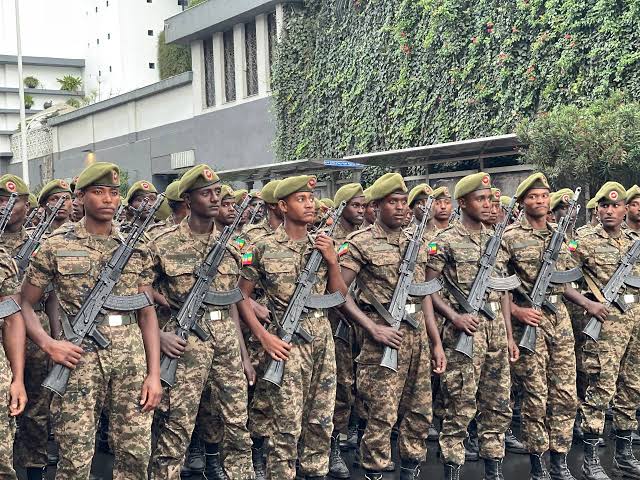
ENDF Soldiers
Ethiopia has once again found itself engulfed in a bloody conflict after only a few years of relative reprieve. This time, the confrontation is no longer limited to the Tigrayan forces.
Recent reporting indicates that the newly announced alliance includes seven armed groups from several regions of Ethiopia. The Amhara Fano and several other armed groups have now joined forces with the Tigray Defence Force (TDF) in opposition to the federal government led by Prime Minister, Abiy Ahmed Ali.
These groups do not share the same political vision for Ethiopia. Their interests, objectives and ideas about the future of the Ethiopian state are fundamentally different.
The Fano, for example, has generally accepted a united Ethiopia mostly under an Amhara leadership objecting the influence of Tigray People Liberation Front (TPLF) federally.
The TPLF on its part has its own distinct conception of Tigray’s political future. For many Tigrayans, the devastating experience of the recent war has intensified questions about their political future within Ethiopia.
Some Tigrayans have increasingly expressed support for an independent Tigray state rather than remaining part of the Ethiopian federation.
The Oromo liberation movement, meanwhile, has a long-standing history of demanding an Oromo self-determination. The OLF’s stated programme has included the possibility of an independent Oromia, while also allowing for a political union with other nations based on equality, mutual interests and voluntary association.
The contradiction becomes even more striking when former adversaries such as Tigrayan forces under the banner of TDF and Fano find themselves sitting on the same side of a new alliance.
These forces fought against each other during the 2020–2022 Tigray war, while the Oromo armed movement has pursued its own struggle in Oromia. Yet they have now found common ground in their opposition to the government of Prime Minister Abiy Ahmed.
This raises a fundamental question about the nature and durability of the alliance. What unites these forces is not necessarily a common vision for Ethiopia, but a common opposition to the current federal government.
Their alliance therefore brings together movements that have fundamentally different answers to one of Ethiopia’s most important political questions: should Ethiopia remain a unified state, be radically restructured, or should some of its constituent nations have the right to pursue a separate political future?
In that sense, the formation of the coalition can be understood as an act of political necessity or desperation rather than evidence that these groups have resolved their profound ideological and territorial differences.
Their immediate objective may be shared, but their ultimate political destinations are far less clear.
The danger is that defeating the Abiy government would not automatically resolve these contradictions.
If these forces were ever to succeed in removing the existing government, they would still have to answer the very questions that have divided Ethiopia for decades: Who owns the state? How should power be distributed? What happens to contested territories? How much autonomy should each nationality have? And, ultimately, does every nation within Ethiopia want to remain within the same political union?
The coalition may therefore be united against a common adversary, but that does not necessarily mean it is united over what should replace the system it seeks to overthrow.
Indeed, the differences among its members could become more difficult to manage once their common opponent is removed.
From the perspective of Gambella Vision, the current political landscape presents a difficult choice: whether to remain with a government whose record has generated serious grievances, or risk replacing it with a coalition whose members hold sharply different and, in some cases, competing visions for Ethiopia’s future.
The old saying that it is better to deal with “the devil you know than the one you do not know” captures this dilemma.
For Ethiopians whose overriding political objective is to preserve a united Ethiopia, the Prosperity Party may therefore be viewed as the more familiar political option compared with an opposition coalition whose members include movements with very different positions on the structure and future of the Ethiopian state.
This does not mean that the Prosperity Party’s record should escape scrutiny or that its policies and conduct should be accepted without question. Rather, it highlights the uncertainty surrounding what could follow if the current government were removed by a coalition whose members have yet to demonstrate a common vision for governing Ethiopia.
For those who place national unity above competing political objectives, the question is consequently not simply who can defeat the current government, but what kind of Ethiopia would emerge after that victory?